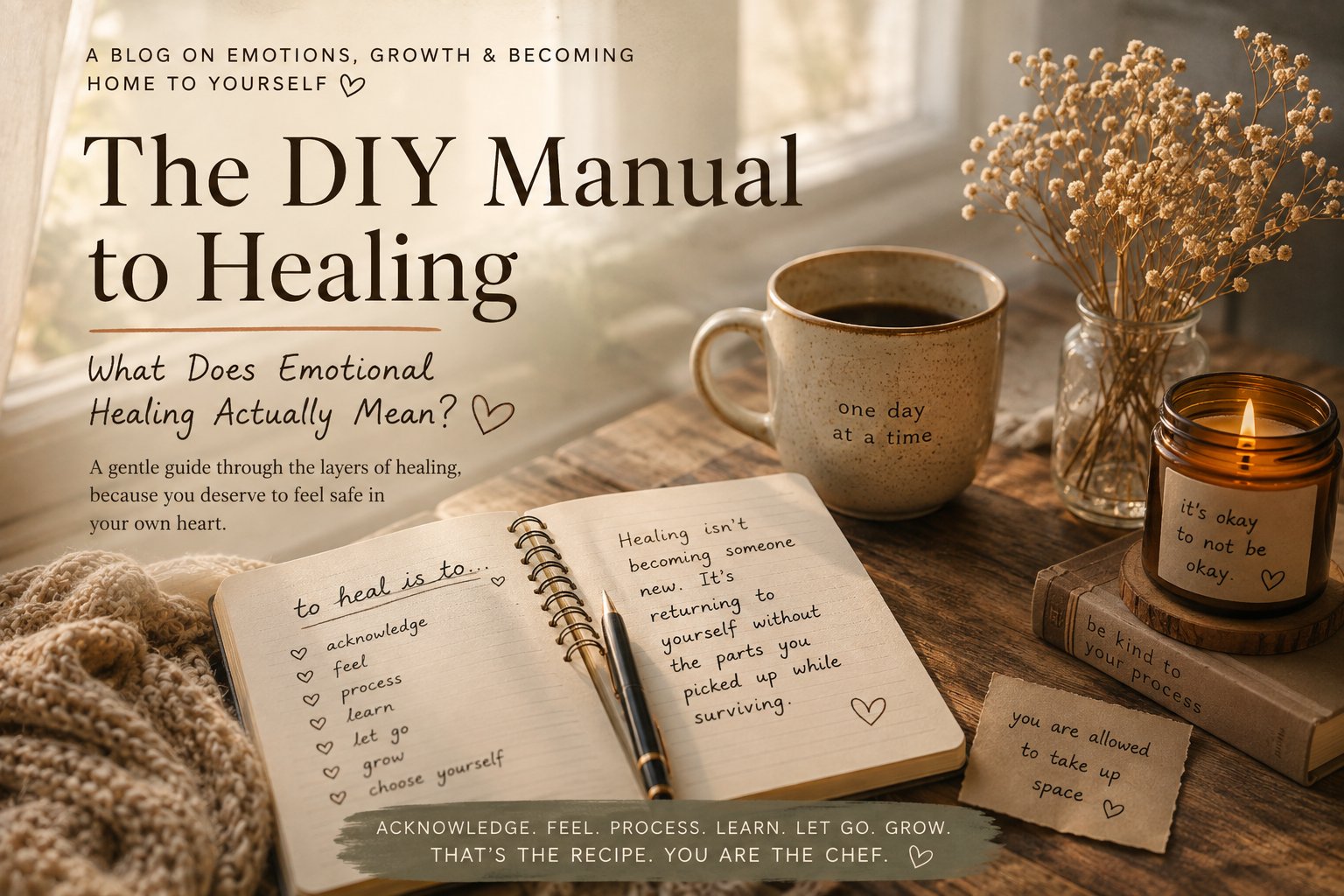

I was having a random conversation with someone and stumbled upon his statement: “We all should heal so no one has to walk on eggshells around us.” This statement left me amazed because I remember someone once saying that I should write about my perspective on healing. Though my bio says that I’m a self-proclaimed literary healer, this in no way means I can literally heal you. It’s more like I can provide you with some metaphors, similes, prose and poetry here and there and hope that somewhere between the words, you find something that makes sense to you. How cool would it be if someone just handed you a DIY manual on how to heal? Before I start rummaging through the pages of instructions, though, let’s first try to figure out what exactly healing is.
In ancient times, a healer would mean someone who could heal your wounds. In modern times, people are perhaps more wounded emotionally than physically, so we have therapists who hold space for us while we spiral and help us make sense of our feelings. Sometimes I’m left with this grey area of how someone can understand us better than we understand ourselves. But maybe there are emotions too large and too complex to be understood by who we are at that exact moment. Humans have this strange tendency to evolve, so the person you are today may have a vocabulary for an emotion that the person you were five years ago could only feel. If something isn’t understandable right now, I won’t jump to the conclusion that I can never understand it. Maybe emotional healing begins much before we know what to do with an emotion.
Layer 1: Acknowledgement
The first and, in my opinion, the most difficult part is acknowledging the emotion. Quite a lot of people struggle here because there’s a thin line between acknowledging what you feel and feeling the need to prove that you are allowed to feel it. The latter is where most people get trapped. People feel a range of emotions from hurt to loneliness to disappointment to anger and almost immediately their brain starts building a courtroom. Am I overreacting? Do I have enough reasons to feel this way? Was I wrong? What if people start watching me differently? What if I’m being dramatic? And suddenly, you’re no longer experiencing the emotion. You’re defending it.
I think we’ve become incredibly good at putting our feelings on trial. Sometimes you don’t need a fourteen-page case file to prove that something hurt you. You just need to admit that it did. Acknowledgement doesn’t mean agreeing with every emotion, and it certainly doesn’t mean every feeling is factually correct or that every reaction deserves to be acted upon. It simply means giving yourself permission to say, “This is what I’m feeling right now.” You don’t have to turn every emotion into a court case with evidence, witnesses and a closing argument.
But there is something we need to establish before we even begin talking about healing. Sometimes you cannot heal in the same place that keeps hurting you. We romanticise healing as sitting quietly with our emotions, journaling about our childhood and drinking enough water, but sometimes the first step is much less poetic. Sometimes it is leaving. Sometimes it is creating distance. Sometimes it is saying no. Sometimes it is admitting that the environment, relationship or situation you are trying to heal from is still actively wounding you. You cannot process a fire while standing inside it and calling yourself emotionally resilient. I think this is where healing sometimes gets confused with endurance. We are taught to tolerate more and call it emotional maturity, when sometimes the healthier thing is to stop surviving something that keeps asking you to survive it. Healing does not always begin with understanding yourself better. Sometimes it begins with getting yourself somewhere you can finally hear yourself think.
Layer 2: Experiencing
Healing is a process that sometimes takes years to show its changes. Similarly, you won’t join a gym today and wake up with abs tomorrow. You won’t start running today and casually complete a marathon by next Tuesday. The idea lies in consistency.
Showing up for your emotions every day is the crux here, but some days are just rant days and you are allowed to feel gloomy. I don’t chase, or want you to chase, the utmost perfection because being flawed is where the humane lies. An interesting part of experiencing an emotion is resisting the urge to regulate it immediately. Sometimes feeling an emotion in its entirety is important before deciding what to do with it. If you become too clever about your emotions, you might start reasoning them away instead of actually feeling them. You may convince yourself that you’re fine because you understand why you’re hurt, while the rest of you is sitting somewhere in the background thinking, “That’s nice, but we’re not done here.” Understanding an emotion and experiencing it are not always the same thing.
This is also where I think we need to be careful with the word “healing” because it can very quickly become another thing we try to perfect. We start monitoring ourselves. Am I regulating properly? Am I responding instead of reacting? Have I processed this yet? Am I healed enough to talk about it? Suddenly we’ve taken an emotional experience and turned it into another performance review. Sometimes you simply need to feel bad without immediately turning the feeling into a personal development project. This doesn’t mean every emotion deserves a microphone, a steering wheel and access to your Instagram account. Feeling something deeply doesn’t mean acting on it immediately. You can be furious and still choose not to send that message. You can be hurt and still choose not to hurt someone else. You can experience an emotion without handing it control over your behaviour.
Don’t start a ceasefire when you’re in the middle of an emotional battle, but also don’t hand the battle commander your house keys.
Layer 3: Processing
Ah, my favourite layer: processing the emotions. The two processors you would need here are regulation and reflection.
An emotion isn’t necessarily a problem that needs to be solved immediately. Sometimes it needs to be allowed to complete its initial wave before you start dissecting it. This is the layer where you peel yourself open a little, not in the dramatic “I have discovered my entire personality through one shower thought” kind of way, but slowly enough to notice what is actually underneath the emotion. What am I really angry about? What exactly hurt me? What am I grieving? What did I expect? What did I need? What part of this belongs to the present and what part of it is carrying something much older? These questions don’t necessarily give you immediate answers, but sometimes they help you distinguish the emotion from the story you have built around it.
Processing allows you to meet the version of yourself that is both sacred and scared at the same time. Then comes a bridge that I think is very necessary to cross: the forgiveness bridge. When I say forgiveness, I mean forgiving yourself too. Not beating yourself up for something that was beyond your control. Not punishing yourself because you didn’t know then what you know now. Knowing the ending doesn’t mean you should have known it at the beginning.
Forgiveness also doesn’t have to look the same for everyone. You can forgive someone and still maintain a boundary. You can forgive yourself without pretending the decision was a good one. You can accept that something happened without deciding that it was okay. Forgiveness doesn’t necessarily mean reconciliation either, and I think we sometimes confuse the two because apparently emotional vocabulary comes with terms and conditions nobody bothered to explain. Think of forgiveness like ice cream. Pick the flavour that works for you. You don’t have to pick the most popular one just because everyone else seems to love it. The goal is to let the emotion have its space without giving it the steering wheel, somewhere between suppression and emotional impulsivity.
And accountability needs to exist here too because healing is not simply about telling yourself that your feelings are valid. Your feelings can be completely valid and your behaviour can still be harmful. You can have an explanation for why you behaved a certain way without using that explanation as an excuse. You can be hurt and still be responsible for not passing that hurt on to someone else. I think this is where the original statement about not making people walk on eggshells becomes important. Healing is not only about becoming safer for yourself. Eventually, it is also about becoming safer for the people who love you.
Why Emotions Were Never Meant to Be Controlled.
Layer 4: The Final Nail in the Coffin
Learning from an experience without letting the experience rewrite your character.
I think experiences make us the edited versions of ourselves, but sometimes we get so invested in editing that we accidentally delete the original. Apps get updated every now and then, but their USP remains the same. In the same way, we need to maintain our authenticity while fixing bugs and updating our versions without completely revamping the whole app. Not every adaptation you made while surviving needs to become a permanent personality trait. Maybe you became quieter because speaking up once cost you something. Maybe you stopped trusting people because someone mishandled your trust. Maybe you became hyper-independent because depending on someone once ended badly. These adaptations may have protected you once, but that doesn’t necessarily mean they deserve permanent residency in your life.
And everybody isn’t responsible for the torn bag. You can’t put all your stuff in someone else’s hands and ask them to take care of it while completely dismissing the stuff they are already carrying. The person you become after being hurt is still your responsibility. Not because what happened was your fault, but because what you do with what happened eventually becomes yours and yours alone.
I’m not asking you to become softer. Maybe just more discerning.
An unhealed person doesn’t necessarily harm everyone around them, but unprocessed pain tends to look for somewhere to go. Sometimes it goes inward through withdrawal, self-blame, self-sabotage, shame and overthinking. Sometimes it goes outward through disproportionate reactions, defensiveness, mistrust and controlling behaviour. And sometimes it goes sideways. You get hurt by person A and accidentally make person B pay the emotional bill. That doesn’t make you a terrible person. It makes you human. But being human doesn’t mean we stop being responsible for what our pain does once it leaves our body and enters someone else’s life.
Not every emotional conversation needs to become a healing session either. You don’t always want someone to ask, “Have you considered that your anger may have originated from an unmet need?” Sometimes you just want someone to say, “OMG, that was so annoying. Tell me everything.” Not every person who listens to you needs to diagnose you. Sometimes they just need to sit beside you while you finish the sentence. Being witnessed in an emotion can itself be regulating.
Layer 5: Closure
Closure and acknowledgement are two different things, which we often treat as one. Sometimes what we’re actually chasing is validation.
You need to understand that your experience doesn’t require the perpetrator’s signature at the bottom of the page to become real. If I’m wearing foggy glasses, I might genuinely perceive the world as foggy. That doesn’t mean the world itself is foggy. It means that’s what I’m currently capable of seeing. Sometimes your interpretation of you is not necessarily the description of you. And if you spend years waiting for another person to acknowledge your pain, they continue to occupy a psychological position in your life. In a strange way, they’re still determining when you are allowed to move on. So we eventually have to learn the strange art of self-closure.
But maybe closure is not always about understanding what happened. Sometimes there is nothing left to understand. Sometimes you may never receive the apology. You may never know why someone did what they did. You may never get the relationship you thought you were going to have. You may never become the person you imagined you would become alongside someone. Sometimes healing is accepting that the thing you wanted closure from is not coming back to close the door. And maybe this is where grief enters the conversation. We talk about healing as if there is always going to be a satisfying conclusion waiting at the end, but some things don’t come with one. Sometimes what you are healing from is not something you can fix. It is something you have to grieve. You can grieve a version of yourself, a future you imagined, a home you thought you would have, or even the person you believed someone was going to become.
Grief also has a strange way of visiting even after you think you’ve moved on. You can be perfectly fine for months and then a song plays, a familiar smell passes by, or you happen to take the same road and suddenly something inside you remembers. That doesn’t mean you’ve gone backwards. Healing isn’t a staircase where every day takes you one step higher. It is probably more like walking through a house you’ve lived in for years. You can enter a room you haven’t visited in a while and still find something sitting there. The difference is that perhaps you no longer live in that room. Healing also doesn’t mean forgetting. I think we sometimes imagine that being healed means being able to remember something without feeling anything at all. But perhaps healing is simply changing your relationship with the memory. The event remains part of your story without becoming the narrator of it.
There’s also a beautiful distinction between the person and the experience of the person. I think this is one of the hardest things for people to accept because we’re taught to categorize emotions and experiences as either good or bad. Something can have been genuinely beautiful and still be unsustainable. A relationship can have been real and still not be meant to continue. A person can have loved you and still have hurt you. You can miss someone and still know you shouldn’t go back. Relationships don’t just reveal who we are. Sometimes they create temporary versions of us, and often those are the versions we fall in love with. But the truth is, that version of you wasn’t created by them. They may have provided the environment in which that version could emerge, but you were the one being that person.
Which means some of what you think you lost might actually be recoverable. Maybe the softness wasn’t theirs. Maybe the laughter wasn’t theirs. Maybe the confidence wasn’t theirs. Maybe they simply happened to be there when you discovered those parts of yourself.
And if you were capable of being that person once, perhaps that person isn’t as lost as you think. So, what is healing? Maybe it is keeping the parts of yourself that were genuinely yours while letting go of the adaptations you developed just to survive. Maybe it is learning when to feel, when to reflect, when to regulate, when to forgive, when to set a boundary and when to finally stop waiting for someone else to hand you permission to move on. And perhaps there is no final version of healed you waiting somewhere at the end of this process. Maybe you keep meeting newer versions of yourself as life keeps happening. You heal something, life introduces something else, you learn something new, you get hurt again, you recover differently. The goal was never to become someone who could never be hurt again. That sounds less like healing and more like becoming a very emotionally expensive refrigerator.
And because apparently every emotional crisis eventually needs a recipe, let’s make one.
Can we have the timer? 3… 2… 1…
Take one cup of acknowledgement, add a generous amount of emotion, mix in a little accountability and add boundaries to taste. Throw in some self-compassion, let the whole thing sit for a while or maybe take a nap, add reflection and finally garnish with self-closure if someone else isn’t providing it, because our dish isn’t dependent on the neighbour’s condiments. Serve warm and preferably with peace.
But here’s the disclaimer nobody puts on the recipe card: this recipe is not universal.
There is no scientifically measured cup of acknowledgement, no universally accepted teaspoon of boundaries and certainly no magical tablespoon of self-compassion that works the same way for everyone. Healing is a little like coffee. You can give ten people the same coffee beans and still end up with ten very different cups. The grind, the water, the brewing time, the temperature and, occasionally, the person making it all change the outcome.
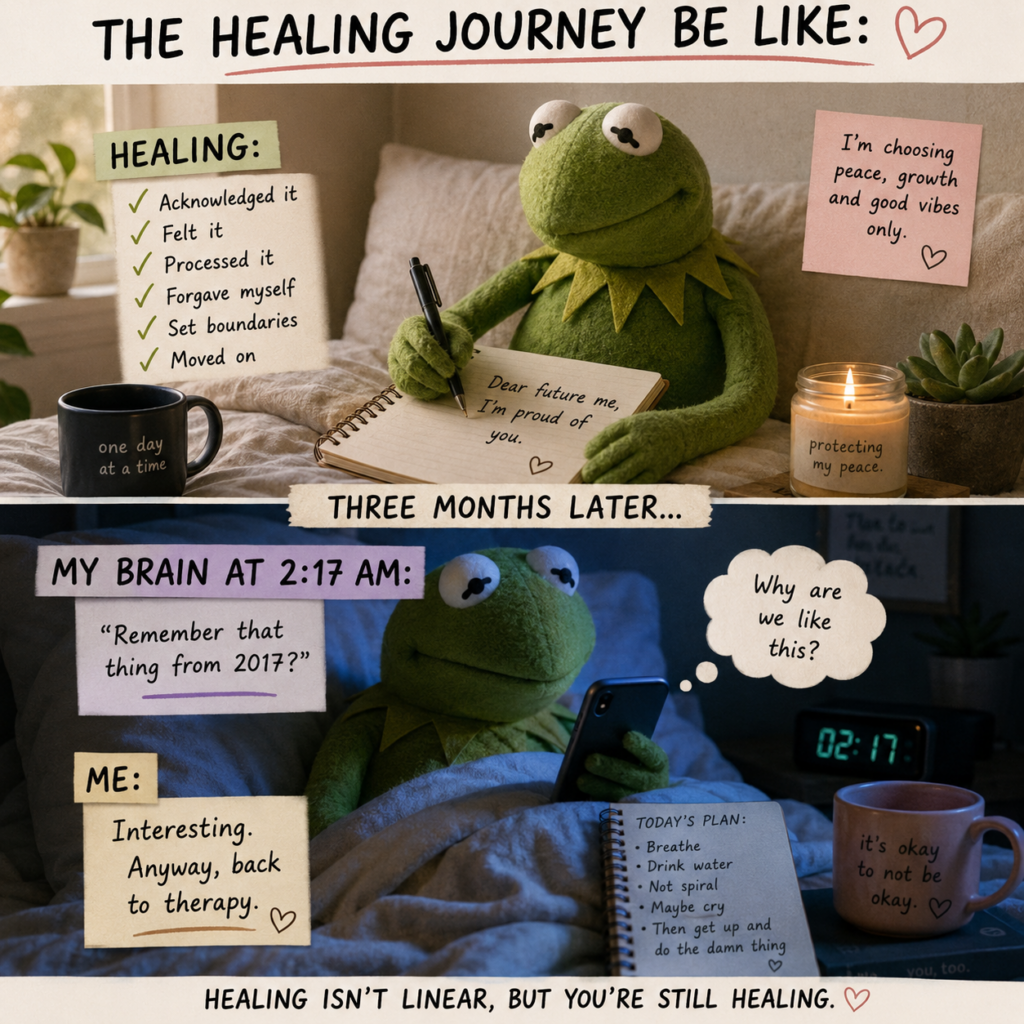
So if someone tells you, “This is exactly how you heal,” take it as a recipe and not a prescription. You may need more time. You may need less reflection and more rest. You may need boundaries before forgiveness. You may need to talk about it. You may need to stop talking about it for a while. You may need professional help. You may even discover that something that worked beautifully for you last year doesn’t work for you anymore.
And that’s okay.
You’re not failing the healing process just because your version doesn’t look like someone else’s. The proportions can increase or decrease depending on the flavour you’re missing the most that day. Maybe healing is not becoming someone who never gets angry, never gets hurt and never makes anyone walk on eggshells around them. Maybe it is becoming someone who notices what is happening inside them and takes responsibility for what happens next. It is learning to say, “This hurt me,” without turning that hurt into someone else’s punishment. Maybe it is learning to leave without needing to hate the person you’re leaving. Maybe it is learning to forgive without reopening the door. Maybe it is remembering without returning. Maybe it is allowing yourself to grieve without interpreting the grief as proof that you haven’t healed.
And somewhere along the way, healing becomes less about becoming a completely different person and more about returning to yourself without carrying everything you picked up along the way.
PS: If you have an intriguing topic, a strange little thought, a different perspective or something you think would make me rummage through my own brain for a while, send it my way. I swear I read my emails diligently. Consider this my official request for intellectual trouble.
Subscribe to get glimpse of literary realm