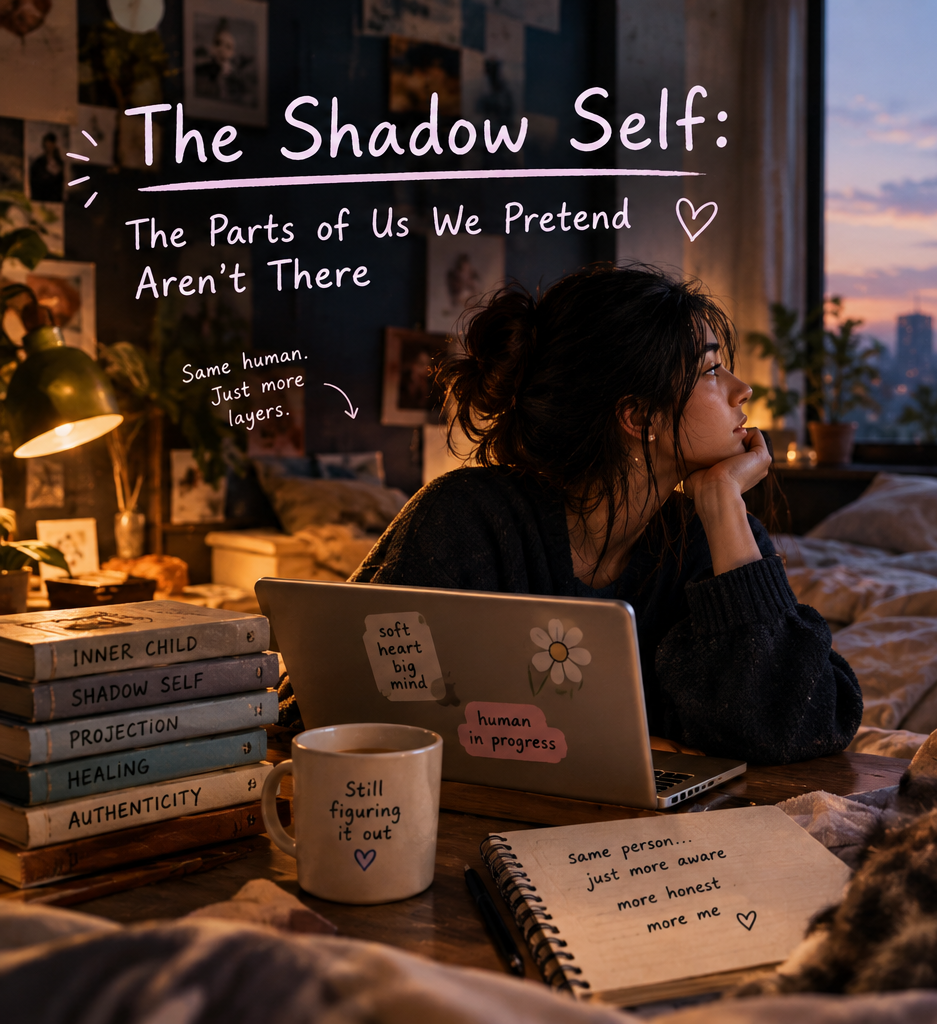

Of all the advancements that ever touched the world, one of the most fascinating among them has to be the clear terminology we now have for our emotions, trauma and mental health. There is something oddly comforting about being able to put a name to the chaos happening inside your head. You are no longer simply having a bad day. Perhaps you are overwhelmed, emotionally dysregulated, overstimulated, burnt out or experiencing some very sophisticated form of existential dread. At least now the chaos has a filing system.
Then came the internet, which decided that if humans were going to have complicated emotional lives, we might as well have terminology for every tiny corner of them. Somewhere between doom-scrolling memes and accidentally watching forty-seven reels about attachment styles, most of us have probably come across the concept of the inner child. The inner child, in simple terms, refers to the younger version of ourselves, the part that existed before we became excessively self-conscious about how we were supposed to behave. Before we learnt that crying could be embarrassing, that anger could make us difficult, that asking for something could make us needy or that perhaps drawing sky-blue mountains with purple houses was not going to win us an award for artistic realism. As children, we were considerably less interested in being digestible. We could announce that we wanted to become an astronaut, a dinosaur, a princess, a cricketer or simply someone who did not have to attend school anymore, and nobody expected us to submit a five-year career plan along with it.
Then life happened. School happened. Family happened. Friendships happened. Rejection happened. Society, with its ever-expanding list of terms and conditions, happened. We slowly learnt which parts of us received applause and which parts made the room uncomfortable. So we edited ourselves. Maybe you became quieter because being loud was labelled irritating. Maybe you became agreeable because disagreement seemed to cost you affection. Maybe you stopped asking for help because needing people made you feel weak. Maybe you became exceptionally independent because somewhere along the way, depending on someone stopped feeling safe. And just like that, without any dramatic announcement, certain parts of you went into storage. (Congratulations, your emotional filing system has now been successfully implemented.)
But today, we are touching upon the shadow self, just to demonstrate that I am also good with corporate slangs. Not literally, but metaphorically. Carl Jung introduced the idea of the shadow as the parts of ourselves that remain outside our conscious identity, particularly the qualities, emotions, impulses and tendencies that we reject, suppress or simply fail to recognize because they do not fit the person we believe ourselves to be. And before we make the classic mistake of assuming that the shadow is basically our inner villain waiting for the right opportunity to ruin everyone’s lives, it is important to understand that the shadow is not necessarily evil. It can contain anger, jealousy, selfishness, ambition, sexuality, vulnerability, assertiveness and even positive qualities that we were never comfortable owning.
Think about it like a house. The version of yourself you show the world is the living room. It is clean, presentable and occasionally has a decorative plant that you bought because you thought adulthood required one. You know where everything is, and if someone comes over, this is the room you are happy to show them. But the house has other rooms too. There is the cupboard where you threw everything five minutes before guests arrived. There is the drawer full of things you swear you will organize someday. There is probably a room you have not opened in years because you already know there is going to be an emotional mess in there and frankly, you have deadlines. The shadow is a little like that forgotten part of the house. It has not ceased to exist simply because you stopped opening the door.
This is where it becomes interesting because most of us have a mental image of who we are, and once we become attached to that image, our brain becomes a surprisingly enthusiastic PR manager. If you think of yourself as kind, you will naturally notice the evidence that proves you are kind. If someone needs help, you help them. If a friend is struggling, you listen. If someone drops something, you probably pick it up. Excellent. Brand positioning: successful. But what happens when you feel irritated because that same friend keeps taking without giving? Suddenly the anger becomes inconvenient. You might tell yourself that you are not angry, you are simply tired. Or you are disappointed. Or you are being understanding. Or perhaps you are just “protecting your peace,” which has become one of the internet’s most versatile corporate phrases for anything from establishing a healthy boundary to silently avoiding a conversation for six months.
The problem is that refusing to acknowledge an emotion does not make the emotion disappear. It simply changes where you experience it. Imagine putting a saucepan on the stove, covering it with a lid and then declaring that because you cannot see the steam, there is no heat. The saucepan, unfortunately, has not received the memo. Our emotions can work in much the same way. Anger that we refuse to acknowledge may appear as constant irritation. Insecurity may disguise itself as judgement. Jealousy may arrive dressed as concern. A desire for control may introduce itself as caring. Fear may masquerade as perfectionism. Even vulnerability, which sounds like such a wholesome thing when discussed in theory, can become something we avoid because being emotionally exposed feels like handing somebody the password to our internal systems.
Healing: A DIY Manual to Emotional Wellness
And this is where projection enters the picture, which is perhaps one of the most fascinating parts of Jung’s idea of the shadow. Projection is essentially what happens when something within us is unconscious or difficult for us to acknowledge, and we begin experiencing it primarily through another person. It is not a deliberate act. You are not sitting there thinking, “Today I shall transfer my unresolved psychological material onto this innocent colleague.” The brain is considerably less bureaucratic than that. Projection happens automatically.
Imagine someone who has spent years telling themselves that they are not an angry person. They are calm. They are reasonable. They do not shout. They do not lose their temper. They are the emotionally mature one in the room. Then they meet someone who is openly impatient, blunt and occasionally aggressive, and they absolutely cannot stand them. Perhaps the other person really is unpleasant. People do, after all, come in all flavours. But sometimes the intensity of our reaction can be interesting. The anger we find unbearable in another person may be a quality we have spent years refusing to acknowledge in ourselves. Not because we secretly behave exactly like them, but because we may have never allowed ourselves to experience anger as a legitimate emotion. So when someone else expresses it freely, it feels almost offensive. They are doing something we have spent years policing within ourselves.
The same thing can happen with qualities we admire. We can meet someone confident, articulate and seemingly comfortable in their own skin and immediately put them on a pedestal. We decide they are extraordinary after approximately three conversations and one emotionally intelligent Instagram story. Suddenly they are everything we wish we could be. We may project qualities onto them that actually exist within us but have not yet been recognised or developed. This is why sometimes we can become disproportionately fascinated by certain people, not necessarily because they are objectively as perfect as our imagination has decided, but because they are carrying something we desperately want to give ourselves permission to possess.
It is rather like looking at someone through a projector. The image appears to be on the wall, so naturally we assume the wall is producing it. But the source is somewhere behind us. We do not see the projector because we are busy staring at the image. Projection can work similarly. We see something in another person and forget to check where the image might have originated.
Of course, this does not mean that every person who annoys you is secretly a reflection of your deepest unresolved trauma. Sometimes people are simply annoying or someone genuinely is rude. If a person keeps taking your food from the office fridge, you are allowed to conclude that the problem might be their relationship with shared property rather than your shadow self. We should not turn self-awareness into another form of self-gaslighting. The point is not to assume that every reaction is projection. The point is to become curious about the reactions that seem unusually intense, repetitive or strangely personal.
And perhaps this is where we can actually do something with all this psychological jargon instead of simply collecting it like Pokémon. The next time someone gets under your skin, you do not have to immediately conduct a full investigation into their personality. Just notice what exactly bothered you. Sometimes the useful part is not what they did but what it touched in you. If someone else’s confidence irritates you, perhaps there is something about confidence that you have not permitted yourself to own. If someone’s neediness makes you unusually impatient, perhaps you have spent years being fiercely independent and have little tolerance for your own dependency. If someone else’s success leaves a strange taste in your mouth, perhaps there is an ambition in you that you have been pretending does not exist. And if someone setting a boundary makes you feel rejected, perhaps you have unconsciously learnt to interpret other people’s limits as statements about your worth.
None of this means you have to turn every irritation into a confession. Sometimes the colleague really is insufferable. Sometimes your friend really was being unfair. Sometimes you are simply hungry, sleep-deprived and one mildly inconvenient email away from resigning from capitalism altogether. Context matters. The point is to develop enough self-awareness to know the difference between “this person did something wrong” and “this person did something that touched a part of me I have not properly dealt with.”
That distinction can change the way we move through relationships. Instead of immediately labelling someone as selfish, perhaps you notice that their selfishness reminds you of something you have never allowed yourself to be. Instead of calling someone controlling, perhaps you notice your own complicated relationship with control. Instead of dismissing an emotional person as dramatic, perhaps you realise that you were taught to swallow every feeling before it reached your face. And instead of idolising someone because they seem to possess everything you wish you had, perhaps you ask yourself why you have decided that those qualities belong to them and not to you.
Because becoming more authentic does not mean becoming a person who has no ugly emotions. That person does not exist. It means becoming honest enough to recognise them without immediately turning them into someone else’s problem. You can be kind and still feel angry. You can love someone and resent something they did. You can be generous and still want recognition. You can be independent and still need help. You can be confident and insecure on the same Tuesday. Human beings are not Excel sheets. We do not come with neatly separated columns where every emotion gets its own cell and nothing overlaps. We are much more inconvenient than that.
Perhaps the real work, then, is not to get rid of the shadow but to become familiar with it. When anger appears, listen before acting. When jealousy appears, do not immediately shame yourself for it. Sometimes jealousy is simply information wearing an unattractive outfit. It can tell you what you want, what you fear losing or what you have convinced yourself you are not allowed to desire. When insecurity appears, try not to hand it the microphone. When you notice yourself judging someone harshly, pause long enough to see whether you are judging something you have never permitted yourself to be. And when you catch yourself projecting an entire personality onto someone after knowing them for approximately twelve minutes, perhaps give your brain a polite reminder that it is not, in fact, the casting director of the human race.
Most importantly, we have to stop confusing self-awareness with self-condemnation. The purpose of looking at the shadow is not to discover that you are secretly terrible. It is to realise that being human involves contradiction. There are parts of us that are generous and parts that are selfish, parts that are brave and parts that are terrified, parts that want closeness and parts that want to run away the moment someone gets too close. Maturity is not choosing one and pretending the other does not exist. It is learning how to hold both without allowing either to run the entire company.
Maybe that is what authenticity actually asks of us. Not that we show every thought we have to the world, because please, some thoughts can remain in drafts. Not that we become brutally honest and start calling it emotional maturity. Sometimes “I am just being honest” is simply rudeness wearing a blazer. Authenticity is perhaps much quieter than that. It is being honest with yourself first. It is knowing when you are angry instead of disguising it as indifference. Knowing when you are jealous instead of turning it into criticism. Knowing when you need someone instead of performing independence. Knowing when you are hurt instead of pretending you are above it. And knowing that another person’s qualities do not become less admirable simply because they awaken something uncomfortable in you.
The shadow, then, is not necessarily the monster hiding underneath the bed. Perhaps it is simply the part of you sitting in the dark, waiting for you to stop pretending you cannot see it. It is the anger you never learnt to express, the ambition you were afraid would make you selfish, the vulnerability you mistook for weakness, the jealousy you were too ashamed to admit, the confidence you kept calling arrogance because you did not know how to own it yourself. It is not asking to become the main character. It is asking to be acknowledged.
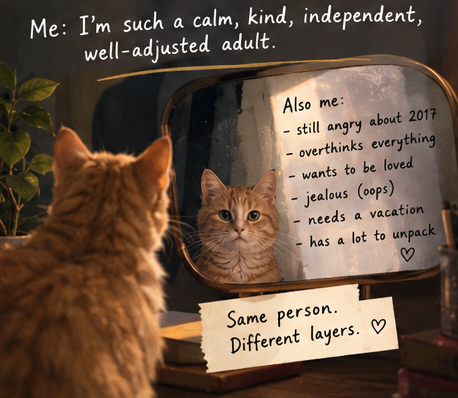
And perhaps the next time someone annoys you to an inexplicable degree, before building an entire psychological profile of them in your head, pause for a second. They may genuinely be annoying. We cannot rule that out. But perhaps they are also holding up a mirror to something you have not wanted to look at. Either way, checking your own face before blaming the mirror seems like a reasonably good place to start.
Because maybe becoming more human is not about becoming perfectly healed, perfectly self-aware or perfectly put together. Maybe it is about becoming honest enough to say, “This is also a part of me,” without immediately deciding that it makes you unworthy of love. The parts we acknowledge can be understood. The parts we understand can be worked with. And the parts we keep pretending do not exist will, eventually, find their own way into the meeting.
Unfortunately, they rarely book the meeting in advance.
P.S. If someone has been getting on your nerves lately, congratulations, you may have just found your next shadow-work assignment. Or they might simply be annoying. (Both can be true, please don’t overanalyze this.) And as always if you think you’re an interesting human, feel free to drop an email.
Subscribe to get glimpse of literary realm