
An 81-year-old writer has just won the Booker Prize for the first time, after spending six decades writing, experimenting and building a literary career. There is something rather fascinating about that, isn’t there? M. John Harrison was announced as the winner of the 2026 Booker Prize on Monday evening in London for his novel The End of Everything. His thirteenth novel, and his first Booker win. At an age when most people are expected to have settled into the idea that their biggest milestones are behind them, Harrison has found himself at the centre of one of literature’s most celebrated moments. It makes you wonder how many remarkable things remain unnoticed simply because they haven’t arrived at the right time, in the right packaging, or through the right door.
But the result isn’t the only thing worth thinking about. This year’s shortlist was described by Gaby Wood, Chief Executive of the Booker Prize Foundation, as being connected by a rather familiar human experience: isolation. Relationships are broken or withheld, secrets and pain are carried quietly, and characters are either shutting themselves away or attempting to reach beyond their solitude. Six very different novels, yet a shared preoccupation with something many of us experience. In a world where we can reach almost anyone in seconds, being genuinely understood still seems to be a rather complicated business. Perhaps that’s what makes this year’s Booker Prize worth looking at beyond the announcement of its winner.
What happened at the Booker Prize 2026?
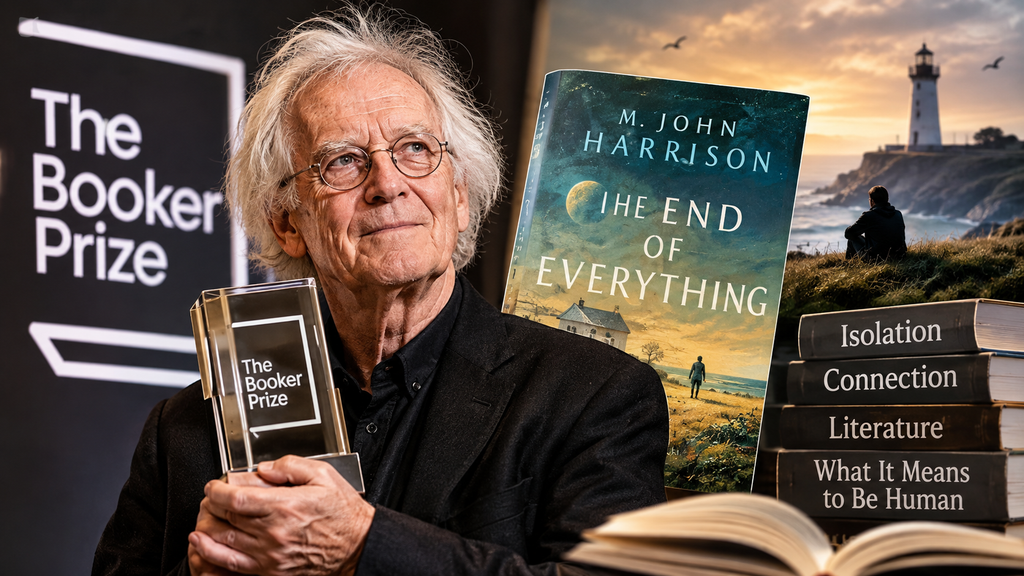
Harrison was awarded the £50,000 prize at a ceremony held at Old Billingsgate in London on 9 November. The decision was unanimous, with the judging panel chaired by classicist Mary Beard. At 81, he is now the oldest author to win the Booker Prize.
The End of Everything, published by Serpent’s Tail, is a dystopian satire set on a near-future Kent coast, where society has been devastated by an invasion of mysterious lifeforms known as the iGhetti. The story follows Phillip Tennent, a beachcomber who survives by collecting objects washed ashore, and his elderly aunt Marnie. Together, they try to make a life in a rather unsettling post-apocalyptic landscape. Harrison uses this imagined world to explore human understanding, social collapse and the explanations we construct to make sense of the world around us.
His win is particularly significant because his work has long been associated with science fiction, a genre that hasn’t always received the same literary recognition as more conventional forms of fiction. Gaby Wood described him as the first Booker winner to emerge from the established science-fiction world. Mary Beard praised the novel for turning readers upside down, raising a wry smile and leaving them with a little optimism despite its subject matter. Harrison has also spoken about drawing on current affairs for the novel’s themes, asking what happens when our expectations and explanations of the world become one ongoing disaster, but life still has to be lived. A rather uncomfortable question, considering how familiar that sentiment can feel.
The six shortlisted novels were The End of Everything by M. John Harrison, The Disappearers by Marlon James, Black Bag by Luke Kennard, May We Feed the King by Rebecca Perry, The Things We Never Say by Elizabeth Strout, and John of John by Douglas Stuart. The list included two previous Booker winners, Marlon James, who won in 2015, and Douglas Stuart, who won in 2020, alongside Elizabeth Strout, who had previously been shortlisted.
Fall in Love with Reading Again: Your 2026 Monthly Book Guide
What connects these six books?
When Gaby Wood spoke about the common thread running through the shortlist, it was the different forms of isolation that stood out. What I found particularly interesting was the question behind it all: how well can we actually know one another? What do we infer, what do we assume, and what are we genuinely prepared to see?
It sounds like a question for a philosophical discussion, but it is also something we encounter in the most ordinary situations. Think about the number of conversations we have in a day. We exchange messages, attend meetings, ask people how they are doing, discuss work, plans and weekend activities. Sometimes we spend an entire evening with someone without discovering anything particularly meaningful about them. We may know what someone does for a living, where they want to travel, what they’re working towards and what they had for dinner. But how often do we discover the more complicated parts of a person? Their fears, contradictions, unspoken thoughts, or the things they haven’t quite figured out how to express?
There is a difference between knowing someone’s routine and knowing their mind. Sometimes an entire room can be occupied by people who care about one another, yet the most important things remain unsaid. We share information, but not necessarily ourselves. And perhaps isolation isn’t always about being physically alone. It can also mean having nowhere to put the parts of yourself that don’t fit into ordinary conversation.
I explored something similar in my piece Deep Conversations: The Lost Art, about our difficulty moving beyond surface-level interactions. This year’s shortlist brought me back to that thought. Maybe that’s why stories about human connection continue to find their way into literature. Sometimes a feeling we cannot explain in a conversation is recognised in a book before we can articulate it anywhere else.
What Harrison’s win says about the way we read
There is another aspect of this year’s result that deserves attention: the recognition of science fiction within literary circles. For a long time, an invisible hierarchy has existed around what is considered serious literature. Certain genres are treated as intellectual exercises, while others are dismissed as entertainment. But why should the setting determine the value of a story?
Grief remains grief, whether it is experienced in a familiar living room or on a fictional coastline after an alien invasion. Questions about identity, memory, power, money and relationships don’t become less meaningful simply because the world around them has been imagined differently. Science fiction has often examined the present by imagining the future, allowing uncomfortable questions to be explored through unfamiliar circumstances. Sometimes, a world that doesn’t exist is exactly what we need to look more closely at the one we already inhabit.
The judges described Harrison’s novel as something that could be read as a thriller, mystery, satire, dystopia, road novel or work of realism. I quite like that refusal to place a book inside a single category. And isn’t that something we tend to do with people as well? We meet someone through their profession, background, interests or the labels they carry, and gradually those descriptions become the entire identity we assign to them. The same happens with books. We decide what a story is supposed to be before allowing ourselves to discover what it might actually offer. Perhaps a little more curiosity, both in reading and in life, wouldn’t hurt.
Recognition, timing and the strange business of being seen
The detail I keep returning to is Harrison’s age and the fact that this was his first Booker shortlist. Thirteen novels, six decades of writing, and an award that arrived at 81. We are so accustomed to measuring progress through timelines that almost everything seems to come with an invisible deadline. By a certain age, a career should have taken shape; by another, financial stability should have been achieved. Relationships, personal growth and success are all expected to follow some imaginary schedule.
Harrison’s win makes that comparison feel a little less convincing. The work had already been done, the books had already been written, and the stories had already been told. The recognition simply arrived much later. In his acceptance speech, he spoke about feeling like a proper writer at last, despite having spent decades publishing novels and building an established reputation.
I found that rather moving because it reveals how much external validation can shape the way we see ourselves. How many people continue doing something they love while wondering whether it counts? How many remain convinced they haven’t quite arrived because nobody has formally announced that they have? Awards matter. They bring readers to books, create conversations and give writers a platform. But a writer doesn’t suddenly become a writer because a trophy confirms it, just as a book doesn’t become meaningful only after a panel of judges agrees that it is. Sometimes the work has been there all along. The world simply takes longer to notice.
Where should you begin?
I haven’t read all six shortlisted novels, so I won’t pretend to rank them or recommend them based on an experience I haven’t had. But the list offers a rather good opportunity to step outside familiar reading choices. If you’re curious about the winner, The End of Everything is an obvious place to begin, particularly if speculative fiction and dystopian satire appeal to you. Readers familiar with Marlon James and Douglas Stuart might want to explore The Disappearers and John of John. Elizabeth Strout’s The Things We Never Say is another interesting choice for readers drawn to intimate explorations of human relationships. And then there are Luke Kennard’s Black Bag and Rebecca Perry’s May We Feed the King, offering two more literary directions.
Sometimes, the best book to pick up is the one you know the least about. No expectations, no preconceived opinions and no pressure to agree with what everyone else thinks. An award can point us towards a book, but it cannot decide what that book will mean to us. That part remains rather personal, and thankfully, no judging panel can take that away.
A last thought
There is a small irony in an 81-year-old writer winning a prize for a book called The End of Everything. Perhaps I’m finding symbolism where there is none, but I like the thought that an ending can sometimes become the beginning of an entirely different conversation.
This year’s Booker Prize has brought attention to a writer whose work has developed over six decades, challenged the boundaries between literary genres, and placed questions of isolation and human connection at the centre of its shortlist. Perhaps the bigger takeaway is that not everything needs to be understood immediately, not every story needs to fit a familiar category, and not every person should be judged by how much of themselves they reveal at first glance.
There are entire worlds sitting inside people, just as there are entire worlds sitting inside books. We only discover them when we are willing to look beyond the cover.
So, which of the six would you pick up first? And have you ever read a book that made you feel understood in a way an actual conversation couldn’t?
Subscribe to get glimpse of literary realm